
Tuesday, February 12, 2008
Disgrasya (Jack and Jill Adaptation )
This video is about a careless student who throws a banana peeling at the wrong place. Someone stepped on it and as a result, this guy fell from the stairs. This video was done by me and the rest of the group 4. Niño served as the cameraman, Edmund was our director and Errl, Christoferd and Ryann J. the banana man, were the actors. Me and Jojie worked during the pre-production. We worked on the story concept and the storyboard with Niño. During the shooting of this film, the two of us just assisted the director, cameraman and the actors. And oh, Vanli Oliveros was also part of the pre-production stage. ☺
With this activity, I have learned basic editing using Adobe Premiere. It was kinda hard and it really takes time but I had a great time. It was also through this activity that I have come to realized that making a film is not as easy as what I have thought. We need patience and there must be unity within the group. ☺

Sunday, February 3, 2008
Trip to Quiapo by Ricky Lee (A Review)
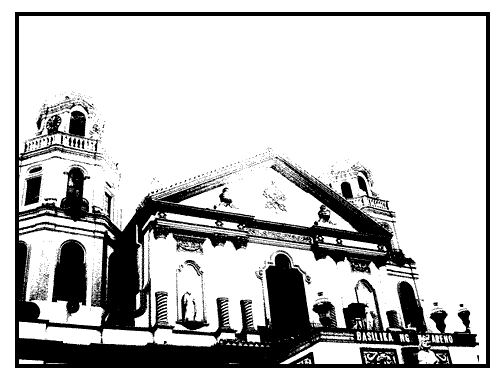
Trip to Quiapo is a scriptwriting manual by renowned scriptwriter Ricky Lee. In this manual, he shares his knowledge, learnings and experiences regarding scriptwriting. It shows a step-by-step process in scriptwriting, from concepts to final draft. Moreover, Lee also shares his ideas about a scriptwriter's life and life itself.
Scriptwriting can be compared as to how we can reach a certain place (e.g. Quiapo); one may choose the usual way which describes a typical writer who follows all the rules in filmmaking and whose works can be predictable and uninteresting; the second one chooses to explore other ways to reach Quiapo, goes first to another place and later on, discovers a new way to reach Quiapo. The second one describes an innovative scriptwriter who chooses to explore the rules and formulas in film and creates unique and creative stories. The last one did not reach Quiapo nevertheless, discovered a place like Quiapo; this kind of a scriptwriter has the courage to break the rules; they are those who can lead the way; they are geniuses and they are those who set standards.
Experience is always the best teacher and so as a scriptwriter, we need to discover new ways in order to produce good stories. Learning the rules, formulas and norms in filmmaking is easy but if we are just to follow all these stuffs, there will be no originality at all. There are no standards as to what a good or a bad film is. Everything changes. As a scriptwriter, we need to find new ways, discover new things and explore more. Let our imaginations rule and allow that "little person" inside us to work tremendously. Look beyond what our eyes can see, think out of the box, allow our emotions and creative ideas rule. Know the rules so you may know how to break it.
Lee also described how scriptwriters and scripts work. The script will be read by the staffs ,it may receive a lot of criticisms and may undergo several changes, the scriptwriter will work together with the director, cinematographer, the editor and other crews. There will be arguments even fights but as scriptwriters, we have to collaborate and work in unity with the production team.
Lee's manual will not teach us how to a write a story instead, Life will be our teacher. According to the author, writing is an act of faith. We have to take risks. We may fail several times but then try, work, and most of all, allow that "little person" to work in us 'til we are able to write a good story. Take courage, be confident, and have passion in everything you do til you are able to discover a new Quiapo.
Trip to Quiapo is a not a typical manual. The mode of writing was informal. The author seemed to do story-telling. He expressed his views, learnings and knowledge through story-telling, setting examples and sharing his personal experiences and personal testimonies from people in the film industry which helped the manual achieve its objectives.
The book is intended for those who would like to learn about scriptwriting. The author's objectives is to share his ideas in scriptwriting and motivate readers. In order to give readers a clear view of what scriptwriting is, the author shared basic concepts, relate it to movies and shared views from people in the film industry. These ways made the book unique because it was not just all ideas but also a mix of experiences.
Aside from discussing about scriptwriting, it was also successful in imparting ideas about life. It gave a clear vision of what life is and shared stuffs on how to bear with unbearable things. There was a part in his book wherein he put a connection between a scriptwriter's work and the usual encounters we have in life. There were dillemas both in scriptwriter's work and life itself. He would always say "take risks" which I would say its absolutely true. Sometimes, we should also get out of our comfort zones to realize that life has more to offer.
But the book befall in some of its film examples. Some of its target reader may be young aspiring scriptwriters who could hardly relate on it. In some cases, its examples were unfamiliar because the movies were way way back. Nevertheless, the book was a motivation for aspiring scriptwriters. It helped in waking those "little people" within us and had helped in shrinking doubts.
Experience is always the best teacher and so as a scriptwriter, we need to discover new ways in order to produce good stories. Learning the rules, formulas and norms in filmmaking is easy but if we are just to follow all these stuffs, there will be no originality at all. There are no standards as to what a good or a bad film is. Everything changes. As a scriptwriter, we need to find new ways, discover new things and explore more. Let our imaginations rule and allow that "little person" inside us to work tremendously. Look beyond what our eyes can see, think out of the box, allow our emotions and creative ideas rule. Know the rules so you may know how to break it.
Lee also described how scriptwriters and scripts work. The script will be read by the staffs ,it may receive a lot of criticisms and may undergo several changes, the scriptwriter will work together with the director, cinematographer, the editor and other crews. There will be arguments even fights but as scriptwriters, we have to collaborate and work in unity with the production team.
Lee's manual will not teach us how to a write a story instead, Life will be our teacher. According to the author, writing is an act of faith. We have to take risks. We may fail several times but then try, work, and most of all, allow that "little person" to work in us 'til we are able to write a good story. Take courage, be confident, and have passion in everything you do til you are able to discover a new Quiapo.
Trip to Quiapo is a not a typical manual. The mode of writing was informal. The author seemed to do story-telling. He expressed his views, learnings and knowledge through story-telling, setting examples and sharing his personal experiences and personal testimonies from people in the film industry which helped the manual achieve its objectives.
The book is intended for those who would like to learn about scriptwriting. The author's objectives is to share his ideas in scriptwriting and motivate readers. In order to give readers a clear view of what scriptwriting is, the author shared basic concepts, relate it to movies and shared views from people in the film industry. These ways made the book unique because it was not just all ideas but also a mix of experiences.
Aside from discussing about scriptwriting, it was also successful in imparting ideas about life. It gave a clear vision of what life is and shared stuffs on how to bear with unbearable things. There was a part in his book wherein he put a connection between a scriptwriter's work and the usual encounters we have in life. There were dillemas both in scriptwriter's work and life itself. He would always say "take risks" which I would say its absolutely true. Sometimes, we should also get out of our comfort zones to realize that life has more to offer.
But the book befall in some of its film examples. Some of its target reader may be young aspiring scriptwriters who could hardly relate on it. In some cases, its examples were unfamiliar because the movies were way way back. Nevertheless, the book was a motivation for aspiring scriptwriters. It helped in waking those "little people" within us and had helped in shrinking doubts.
Subscribe to:
Posts (Atom)


 Posts
Posts


